Mid Year Reflection

My Vosaic report gave me some solid insights into my small group reading instruction. It highlighted my strengths in creating a supportive and engaging space for comprehension, which is something I work hard at. It also clearly pointed out where I can improve my explicit instruction, especially when it comes to helping my students make meaning from text in a more structured way.

I can see from the report that I have strengths in leading discussions about the content of a story. My next big step is to make the strategies for understanding that content much more visible for the students. This is where BSLA and its focus on structured teaching comes in.

The report shows me that while I am asking good follow-up questions, I need to challenge myself to make them even deeper. I am aiming for more inferential thinking from my students so this will be my next step.


Manaiakalani Cluster Teacher Only Day - Hanga | Create

The creation process requires students to actively manipulate information rather than passively receive it. This involves:


  • Decomposing complex ideas into component parts

  • Reorganising information in new ways

  • Making explicit decisions about what to include or exclude

  • Testing their understanding by attempting to explain or represent it


Today we were set the challenge to create and share using 21st Century skills and to think what current and future technologies we might utilise to empower our students creativity.


2025 Inquiry

As a school we began the year with new learning using the structured Maths approach. We would be using the Numicon resource and programme with our Year 1s to 3s. This was our team intended inquiry but beginning our teaching using the Numicon resource was delayed due to a delay in receiving our equipment and we felt we needed time to get to know the new resource.

As a team we decided to look at the comprehension aspect of our literacy programme, using the BSLA teaching tool with our classes as we were all trained the previous year.

BSLA provides a clear scope and sequence for teaching phonological awareness, phonics and high frequency words. We follow and use this systematically with our small groups to ensure a strong foundation. As part of this programme we also have a strong "reading to" programme. Reading aloud to akonga and engaging in rich and complex texts builds vocabulary and listening comprehension which is the precursor to reading comprehension.

However we felt that while there is a strong focus on the decoding of texts with the Phonics Plus texts that once the students move on to the Ready to Read texts there would be quite a shift in terms of story and theme and perhaps the children would not have the skills required for these texts.  

Talking to my team, we felt that while we would be limited by time constraints, that incorporating a more intentional comprehension focus to our small reading group sessions would be the goal for our inquiry. 

The groups of children I have decided to focus on have good sound to letter knowledge and are able to blend simple 2 and three letter words. They do however lack fluency and spend a lot of time decoding words. This means that they are working just below where they should be on the BSLA programme. 

I will be recording the discussion part of my reading lesson using Vosaic. I will have a focus on comprehension and be reflecting on the effectiveness of my questioning, observing my interactions with my students as they answer literal and inferential comprehension questions about a text. 


End of year reflection - Inquiry 2024

As we come to the end of the year I have reflected on another very interesting year in my professional learning. 


I began the year with a focus on Numeracy with my class of Year 2's I share with Ms Squires. I had some big ideas as it was the first time I had taught Mathematics in many years due to having had a focus on small literacy groups. 


I began therefor with JAM data and a big question; How do I best build retention of facts and support children to apply these in multiple contexts? This stemmed from what I believed was a lack of understanding around maths concepts; Did the children know what they were trying to find out? What was the best strategy to use? What facts did they know that would help them with the problem?


I began with JAM data and moved swiftly into Reading data with the exciting news I was to begin BSLA training mid year. I would be enrolled in the University of Canterbury Micro-credentials course. This course supports teachers to understand the research behind the approach and help them scaffold changes to their teaching practise.  


So at the start of term 3, I changed my inquiry focus to match my new role as the BSLA teacher for small groups. I am now focused solely on teaching the Better Structured Literacy Approach (BSLA) with two classes, Rooms 11 and 13, as well as teaching the Taumata in Room 23.


This is just the start of my learning on the structured literacy journey but I can already see the changes in my students confidence, their growth in understanding of how to apply their knowledge of spelling patterns and phonics to their reading.


Teaching as Inquiry 2024

This year, as well as taking my small literacy groups, I am also back in a Year 2 class team teaching with Ms Squires in Room 23. I am teaching Maths to the whole class and will be undertaking the BSLA training in Term 3. I am really looking forward to learning this approach to literacy and seeing what benefits it can have for both my class and my literacy groups.

I am excited to see what the intervention can achieve over the ten weeks in terms of improvement in both areas of reading and writing for both my small groups and my Taumata group in Room 23.


Teacher Inquiry 2024

This year my area of focus for Inquiry is Mathematics.  This is the first year in many years that I have taught Mathematics in the classroom and I am excited about this new focus.

I have chosen to focus on a small group of six students, two male and five female. These students have all had one full year at school and are working around Early Level1 for their Additive Strategies.

My initial data for this group has been gathered from their JAM test taken in Term 4 last year. The data tells me what they have achieved on Level one of the curriculum. What I need to discover next is what they understand about maths concepts and the strategies they have been taught. This I believe is the key for this group of students.

My inquiry question; How do I best build retention of facts and support children to apply these in multiple contexts? stems from what I believe is a lack of understanding around maths concepts; Do the children know what they are trying to find out? What is the best strategy to use? What facts do they know that will help them with the problem?

My first step is to find out just what they understand about Math concepts!


Teacher Only Day Refelction

We began our Teacher Only Day by taking a look at the data collected across the cluster on reading, maths, and writing.  After breaking into small groups we looked closely at which student groups had made progress, acceleration, showed a shift and those that had gaps. 

The highlight of this very interesting and informative teacher only day with our Manaiakalani colleagues was the Little Mad Scientists Create workshop hosted by the very clever and talented teachers from Glen Taylor School. This was divided into three areas; the Living World, the Material World and the Physical World. We broke into three groups and did a hands on Create activity promoting young children's fine motor skills, creativity, cognitive development and language accumulation. They used provocations to promote student interest and then provided a range of hands on activities for us to participate in reminiscent of early childhood activities that are well set up and structured so children can learn by doing. 


End of year reflection.


Quick 60 uses Nonfiction content and therefore the programme caters well for the ESOL children’s needs.
Nonfiction texts offer topics that tie in with their personal interests and give them a broader vocabulary base. There is plenty of room for discussion and the comprehension elements of this programme mean that the children are engaging in thinking around the context and have many opportunities to acquire new vocabulary in a carefully scaffolded manner.

As part of my inquiry this year I looked at how I could improve the achievement of students with additional needs in the learning areas of English/key competency using language symbols and texts, in reading using language acquisition. I adapted my tasks to enhance learning, enable access and improve comprehension. I used specific teaching prompts, encouraging the use of rich vocabulary and conversational oral language to strengthen comprehension by introducing follow up conversations to my lessons.

At the start of each lesson I have the children repeatedly read their known books to help them become familiar with text and develop fluency. After reading their new book to me they then do tasks that develop skills in looking for information in their text and answering both inferential and literal questions.

I hope to work more in this area next year as I saw good results from the children who improved in their EOY Running Record results as well as in their comprehension.


Target group mid year spotlight

 How are we going?

I started the year very excited about picking up my Inquiry focus from the previous year, this was meant to be the tidy year! No more lockdowns to interrupt the learning, better attendance, and better health! So far the only part of this that has happened is the lack of lockdowns.  

Poor attendance and health have been a huge obstacle for both myself and my students. Two bouts of COVID, an injury and frequently needing to be an emergency cover for other staff members has meant my programme has not been consistent at all. 

However, despite all this, the children have made fantastic gains! Discussing their progress both in class and on the programme with their class teachers has been very positive. The challenges we are all facing are the same but the children are making wonderful gains.

The graph shows the gains made between February and May. It shows that all children have made gains, the green bar showing the reading level gain is very exciting! Two of my focus children left before May.


Inquiry 2022

 My 2022 Inquiry Focus:

Using the Quick 60 programme, specific teaching prompts, and the use of oral language to strengthen comprehension, will I see a significant improvement in scores for both Running Record levels and comprehension question scores for the identified students?


The Manaiakalani CoL Achievement Challenge that I am basing my inquiry around is;

Improve the achievement of students with additional needs in the learning areas of English/key competency using language symbols and texts


End of year Inquiry Data and Success!

Many students made significant gains in their mid-year PM test. 

There were significant gains made by children who began at Level 14 (Reading age 6 years) (Chron age 8 years) who at their mid year test were reading at Level 21 (Reading age 8 years)


I have designed tasks that are specifically re-tell, prediction and making connections to the text as well as learning about specific parts of words.


In the middle of Term 3 we went into a long lockdown online learning period. This halted most of the progress these children made and many did not return in Term 4 for me to test. I can only use the mid year data and any running records I took in Term 3 to form a picture of where the children are now at.


I am happy with the progress they made and can only imagine how successful they would have been without the lockdown interruption.


Inquiry 2021

I have a group of children who didn't achieve as they should on their end of year running records due to the comprehension. They have very good decoding skills so I plan to use the Quick 60 programme and specific teaching prompts to encourage the use of rich vocabulary and conversational oral language to strengthen comprehension by introducing follow up conversations to my lessons. 

At the start of the lesson children will repeatedly read their known books to help them become familiar with text and develop fluency. 

They will do tasks after reading that develop skills in looking for information in their text and answering both inferential and literal questions. 


DFI Reflections - Reflections

Today was our final day learning online together in our DFI group. The last 9 weeks have been an incredible learning journey for me, all the things I have wondered "how do they do that?" I now know how to do and my students are definitely benefitting from my new found knowledge! 

I am proud of how much I have up-skilled myself, I am really excited to keep up-skilling and have so much more confidence to join in online learning where I would never have before. I regret not trying Toolkits before now, I see so much future learning for me using this platform. 

Moving forward I know I will be much more able to support and engage my learners online using my site as a learning place where before it was purely a tool for storing my planning.

My new word for the day is Ubiquitous and my goal is to be able to say this as well as Mrs Burt! Ubiquitous - Anytime, Anywhere, Anypace! 


So today was Exam day! I couldn't get stressed about this, my son was sitting his Level 2 mocks today and I had to be a good role model for him!  Now we wait for the results! I found that I finished with a really good amount of time to spare..if that is a good thing or not we will see! The knowledge I had from our time together learning really did give me the confidence I needed and all the scenarios seemed to be from things I had experienced with a little new learning thrown in to test me!


I have loved learning with our Bubble Group, I want to say a massive thanks to our facilitator Vicki Archer, you answered all our questions regardless of what they were, you supported us and helped us de-bug when we needed that too! Thanks to our lovely supportive bubble, I loved "meeting" you all and hope we stay in touch! What an amazing group of talented individuals we are!


DFI Reflections - Computational Thinking

Today in DFI we began by looking closely at the Manaiakalani kaupapa of Empowerment, the advancing of Rangatiratanga; of taking back control of their own lives. 

Thinking about how we use devices and that devices are not "just a tool." It is about overcoming barriers of distance and time (NCZ) We have spent the past 8 weeks unlocking the digital tools required to make learning more engaging to the students. 

The things that disempower families and our students; money, rental properties, landlords, health, education etc. All these things are out of our control as teachers, what things can we control to make the difference? 

Becoming digital for our families was in a sense giving them the tools to take control and be empowered.

This week we looked very closely at computational thinking. The way we looked at different digital tools made me realise how much scope there is in both literacy and numeracy for student engagement. 

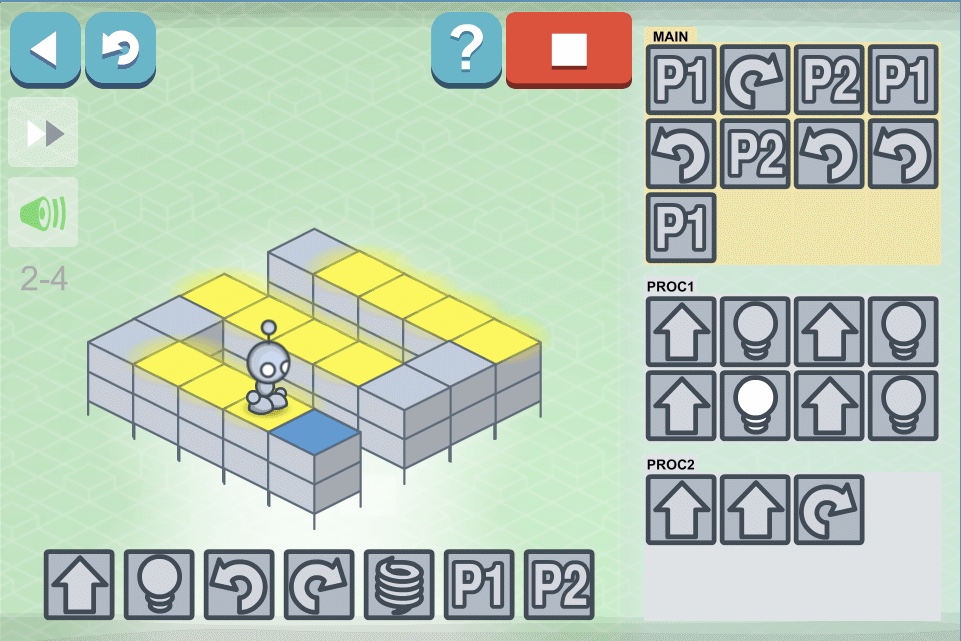
I had a play using Lightbot which I can immediately see many benefits in both literacy and numeracy; following or giving instructions, using direction.

Next I used Gamefroot to help create my mihi. I enjoyed this very much, I was able to troubleshoot when the game would not go any further, it was interesting seeing how one tiny mistake could cause the whole game to cease working and to find where I had gone wrong and fix it myself. Troubleshooting as a complete novice gave me a sense of accomplishment that the students would enjoy I think.

Lightbot


Gamefroot - Mihi Maker

DFI Reflections - Devices

Today focused on the devices our young people use in their classrooms and we experienced Learn Create Share using Chromebooks and iPads.

The use of devices from the student's view helped me understand some of the frustrations the students could be feeling when using their devices to complete tasks. A lack of visibility due to the small screen or different brightness would affect how much learning they experienced and it made me mindful when designing my learning tasks of avoiding the moving of small objects, filling in of small boxes, low quality or small images.

Utilising the device I don't normally use from the teacher's view, helped me gain new knowledge about shortcuts, and how I could make use of those myself. 

Today's task was to develop an activity around Cybersmart using Explain Everything or Screencastify.

Having not used iPad's myself before for learning I decided to have a look at using Explain Everything. I quickly realised there is huge scope for designing activities using this format. I am looking forward to having a closer look at what can be created here!


DFI Reflections - Enabling Access- Sites

Today was a really interesting day for me having a look at what makes a site easy to navigate and how to enable access.  We spent much of the day looking at the different components of good sites and in our fabulous wee group who are all now feeling like good friends and colleagues we gave advice to each other to help improve our own sites. My site by the end of the day looked a whole lot different but I think that is testament to the quality feedback my group gave me.  I feel confident that my site will be a lot more useful to the learners and their teachers and that I will be able to update it easily from now on.

Please have a look at my site and leave me some feedback! 


DFI Reflections - Collaborate - Sites

This week in DFI we learned about Collaborate-Sites and how to use Multi-Modal Learning.  This was a new concept for me and I learned many new things here! I am very excited about trying this out with the texts I use in Quick 60! During Level 3 lockdown I have been thinking of how to meet the children's needs in this time of online learning and think this would be a great way to do this. This is my Multi-modal site about Pigeons.


DFI Reflections - Dealing with Data

Today's new learning for me was My Maps. This is something I had never used before but can see how useful it would be in the classroom as a Maths tool; What a great way to teach perimeter, length, distance and time! I can see so many uses in the classroom and in my own daily life.

This map I created looks at places I like to visit in Auckland and would share this with visitors. 

My Maps


The second new learning for me was around data and ways to manage it effectively.  I had used spreadsheets as a tool before but mainly to store information such as testing results and attendance tracking.  I was really keen to learn more about how to manage the data and use it.  The benefit of being able to track progress, identify and manage target students and monitor their progress is endless. I can see many opportunities here for me to use sheets t better inform my teaching.

Spreadsheets


This spreadsheet looks at blogging data over a period of three years. It shows that this person on average blogs 3-4 times per month, if we were to break it down further it would most likely show a blogging history of once a week.

Keeping track of this information is very important and helps to identify children's needs.

DFI Reflections - Media


"Creativity focusses on the process of forming original ideas through exploration and discovery" Kohl 2008. One of my favourite events of the year is the Manaiakalani Film Festival, seeing the students and teachers creativity celebrated on the big screen is always incredibly inspiring. Hearing the children talk about the films they create reminds me I must always strive to learn more so that I can provide meaningful learning experiences for them.

Today Dorothy talked to us about the 'Create' part of the 'Learn, Create, Share' pedagogy and our session was focussed on Media; how we can use this to enhance the children's learning. We learned how to use Google Drawing, Slides and YouTube effectively as a creative learning tool. 

For me, this was a very interesting session as I have only used Google Slides for my planning and today showed me new and creative ways to use it with the children.  I hope to be more efficient in my planning with this new knowledge and to create tasks for the children using what I learned. This is an example of using Google Slides as a learning tool.

DFI Reflections - Workflow

Today in DFI we started by looking closely at the Manaiakalani Pedagogy: Learn Create Share, with a close focus on Learn/Ako. I came away thinking about the knowledge and skills I gained in my years of teaching both in the classroom and small group literacy and how in the last 2 years I have taken that knowledge and increased my effectiveness as a teacher by integrating digital technologies. My planning and monitoring of the children's progress is already more effective and with the DFI skills taught I believe I will see an impact on the achievement outcomes.  

We spent some time looking at new ways to manage our workflow. We looked in depth at Google Meet, Keep, Gmail, Calendar and Tabs.  These are tools I have explored myself as a teacher with limited digital skills and used lightly and sometimes inefficiently. I feel now I will use them far more effectively and this will benefit my students and their teachers greatly. 

Using Google Meet to discuss a blog post, I was able to practice a new way of collaborating with a colleague, I would like to practice this to develop the skill more, I was concerned I didn't have my screen shared and if I needed to read the work aloud, but that is something I think I can develop more confidence in using and see potential in using this in the future. I would like to use this with the students I teach so that they can record their reading aloud and talk about their learning with a buddy.

I am looking forward to learning more about these tools that I have only lightly used in the past and seeing how they will benefit the students I teach.


Mid Year Reflection

My Vosaic report gave me some solid insights into my small group reading instruction. It highlighted my strengths in creating a supportive a...